Tempering Eggs 101: A Beginner's Guide to Smooth Custard Bases
Tempering is the ninety seconds that decide what your custard becomes. Pour hot milk into beaten eggs all at once and you get sweet scrambled eggs floating in warm cream. Add that same milk slowly, whisking the whole time, and those two ingredients turn glossy, thick, and spoon-coating. The technique costs you one extra bowl and a little patience. Here is how it works, why it fails, and how to rescue a batch that has already started to go wrong.
Why Hot Dairy Turns Eggs Into Scramble
An egg yolk is mostly water with proteins suspended in it. As the yolk warms, those proteins unwind and link together into a loose web that traps water and thickens the mixture. That web starts forming somewhere around 180°F. Push much past that and it tightens, squeezing water back out — and what was smooth custard turns grainy and weepy.
Pouring boiling milk straight into cold eggs dumps a lot of heat in one place, and the proteins in that spot set instantly. Tempering spreads the heat out. You add hot dairy in small amounts so the eggs climb toward temperature gradually, and by the time the mixture returns to the pan, nothing has been shocked.
Sugar and starch change the margins. Both raise the temperature at which eggs set, which is why pastry cream with cornstarch and a generous amount of sugar forgives more clumsiness than a plain crème anglaise.
Set Up Before You Turn On the Heat
Tempering goes badly when you have to hunt for a whisk mid-pour. Have all of this within arm's reach before the dairy hits the stove:
- A heavy-bottomed saucepan. Thin pans create hot spots that scramble eggs.
- A balloon whisk for the eggs, plus a heatproof spatula or wooden spoon for the pan.
- A ladle or spouted measuring cup, so you can add hot dairy in a controlled stream.
- A heatproof bowl big enough to hold the eggs plus all the dairy, with room to slosh.
- A fine-mesh strainer, which is your insurance policy.
- An instant-read thermometer, if you own one. It removes most of the guesswork.
The Tempering Method, Step by Step
- Whisk the eggs smooth. Combine yolks, sugar, and any starch until the mixture is uniform and slightly pale. An unmixed streak of yolk will set into a visible thread later.
- Heat the dairy gently. Warm milk or cream over medium-low until it steams and small bubbles ring the edge, around 170°F. Don't let it boil.
- Add a splash. Ladle about two tablespoons of hot dairy into the eggs while whisking constantly. The bowl should feel warm, never hot.
- Repeat, a splash at a time. Keep adding in small increments until you have worked in roughly a third of the dairy and the mixture is warm to the touch.
- Stream in the rest. Pour the remaining dairy in a thin, steady stream, whisking the whole time. Aim for the side of the bowl rather than directly onto the whisk.
- Cook to thicken. Return everything to the saucepan and cook over medium-low, stirring without pause and scraping the bottom and corners, until the custard coats the spatula. This usually takes three to eight minutes.
- Strain and chill. Pour through the fine-mesh strainer into a clean bowl, stir in vanilla or butter, and cool.
Small Details That Buy You Room
Most failed custards fail in one of four places.
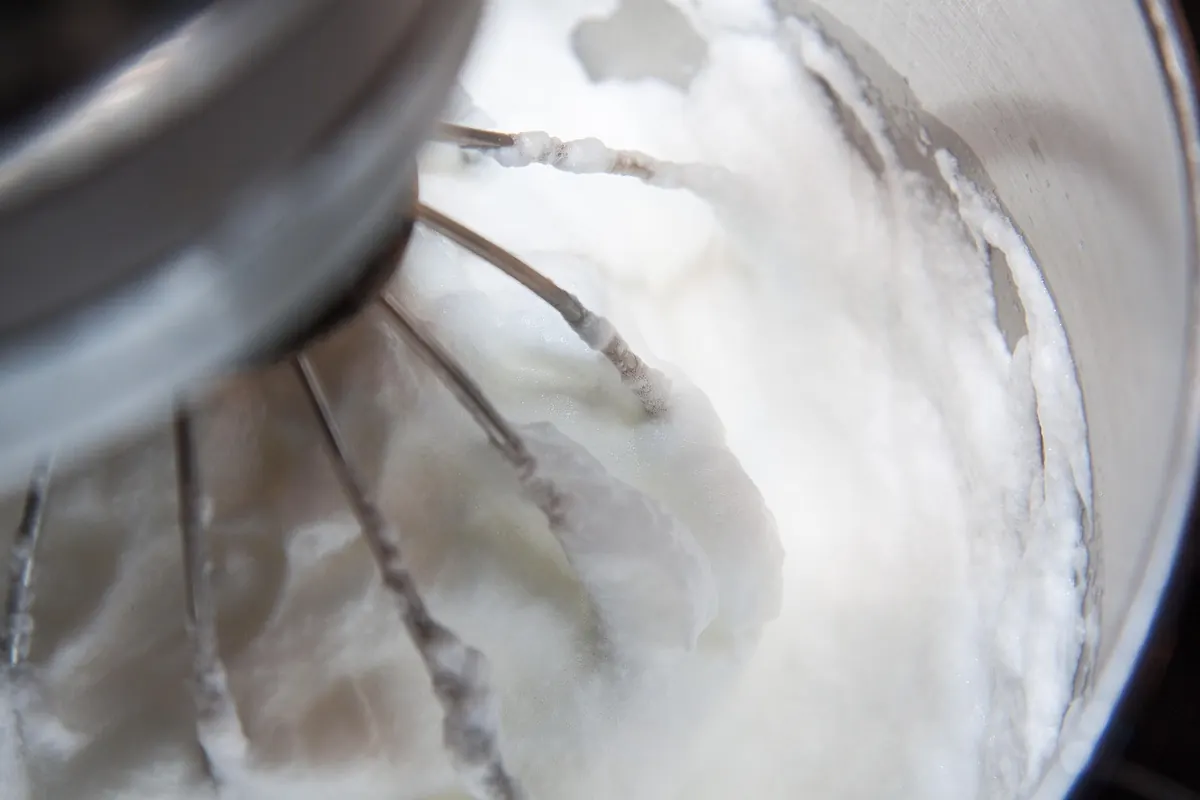
- Whisk the eggs, not the air. Constant motion is what matters. Whip hard enough to build foam and you get bubbles that bake into a spongy texture.
- Scrape the bowl. Egg sitting at the bottom never gets incorporated, and it takes the full heat of the first addition. Run the whisk around the base with every stroke.
- Keep the pan heat low. Once the tempered mixture returns to the stove, medium-low is plenty. High heat thickens faster and curdles faster.
- Mind the finish line. Custard is done around 170°F to 180°F, when it coats a spoon and a finger drawn through the coating leaves a clean line. Above 185°F you are gambling.
A little hot dairy goes into the eggs. Not a lot of eggs into a lot of hot dairy.
Troubleshooting
A few specks of cooked egg
Strain it. Small bits of set egg catch in the mesh and the custard underneath is usually fine. This is exactly why the strainer is non-negotiable.
The eggs scrambled badly
Don't pour it down the sink yet. Strain the mixture, pressing the solids gently to get all the liquid through. If you have lost a lot of body, chill the strained custard, whisk a fresh yolk with a spoonful of sugar, temper the cooled custard back into that yolk the same gradual way, then cook the whole thing gently until it thickens. You end up with a slightly leaner custard that tastes perfectly good.
It won't thicken
Nine times out of ten it just needs more time over gentle heat. Stir with a spatula so you can feel the bottom of the pan and catch any sticking before it scorches. If it still refuses after ten minutes, the ratio of eggs to liquid is probably too low: strain it and finish with a cornstarch slurry — a tablespoon of starch whisked into a tablespoon of cold milk — cooked in for a minute.
It thickened, then turned grainy and thin
That is the protein web tightening and leaking water. Pull the pan off the heat immediately, whisk in a splash of cold milk or cream, and strain. Serve it soon rather than reheating it, since it will be less stable the second time around.
Practice, Then Branch Out
Tempering rewards repetition more than reading. Make one plain vanilla custard this week and pay attention to two things: how long it takes to thicken in your pan, and how the mixture feels on the spatula just before it does. Those two signals will serve you better than any timer.
Once the basic move feels routine, the same technique carries you into pastry cream, ice cream base, crème brûlée, and lemon curd, where you temper eggs with hot citrus instead of dairy. If you are cooking for anyone pregnant, elderly, or with a compromised immune system, use pasteurized eggs or make sure the finished custard reaches 170°F throughout.
Photo: stux / Pixabay